I don’t think enjoy is the right word for it. I think passion is the right word for it.
I don’t think enjoy is the right word for it. I think passion is the right word for it.
I find that through our many interviews people describe their flow activity as something they do alone that benefits them directly. I also feel that for some people they find flow in things they don’t even realize or take a notice to. The thing could also be used to benefit others and also bring the best out those people. It could be something like teaching or giving up your time in order to help other people. These things may sound to some people like things that are not too desirable or something they could become fully immersed in, but for those special people I think it is very possible. I believe that sometimes the activity itself may not be what we are totally in love with, but the outcome that makes the activity unquestionable and pass easily.
One of my teachers is a prime example of this. If you look at the many things she is involved in, you find it hard to believe. And not only does she complete these tasks, she does it with a smile on her face. I know for the most of us, we see this and we might sometimes take this for granted. She consistently puts in long hours all so that she can see her students succeed. She is at school at 7:30 for meetings carrying a box of doughnuts for the various activities she is involved in – and still there at 5:00, assisting students or working on school jobs.
Why is this? Not many people I know could handle this type of workload that she takes on. I like to think that she takes a sense of flow into all these activities, knowing that she could potentially change these students’ lives. She knows that what she is doing now, although it may be tough, changes her students for the better.
This type of flow, in my opinion, is the best type there is. It is powerful, and it is so selfless and kind.
Real achievement comes by being engaged, by being excited by things, by having your curiosity awakened and stimulated. It’s the heart of good education. And I think good teachers should know that… that if you can find that spot in people’s lives where their passion meets their talent, they’re going to achieve far more than if they are sitting there, disengaged.
When you find something that you really love, I guess the time just doesn’t really matter.

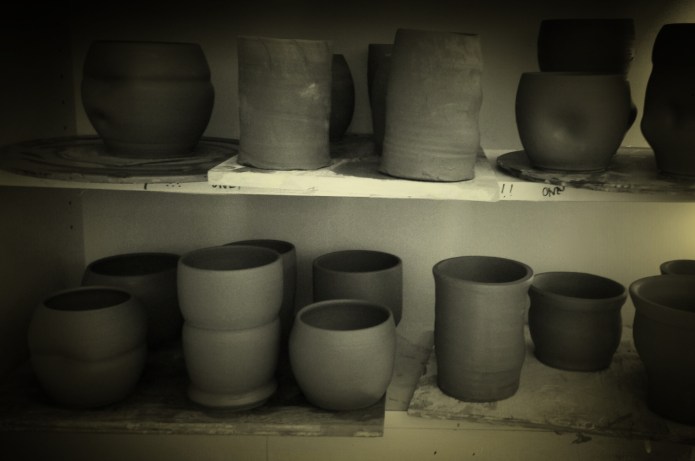
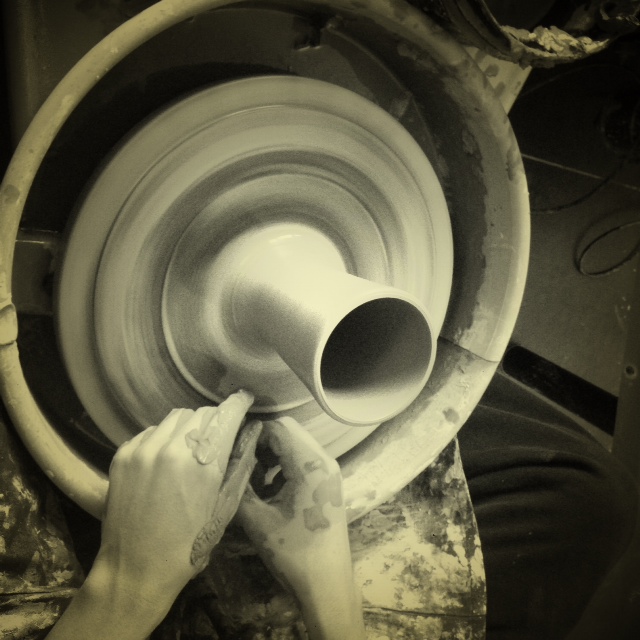 I found myself in a predicament this week at the wheel. For the past year, I have spent much of my spare time in the ceramics studio without even having a class, but most of this time was spent throwing bowls. From making them for Empty Bowls to just making them as gifts, bowls really became the only thing I made. It was what I enjoyed making, or maybe just what I was comfortable with, or maybe its just where I found my “flow”.
They say ceramics is like riding a bike – you never forget. This may be true, but I found that my hands no matter how hard I tried kept instinctively making that classic bowl shape. They all differ in some ways but always end up looking the same. From trying to make a teapot in my Ceramics III class, to the task of making 30 red cups, I became frustrated with myself.
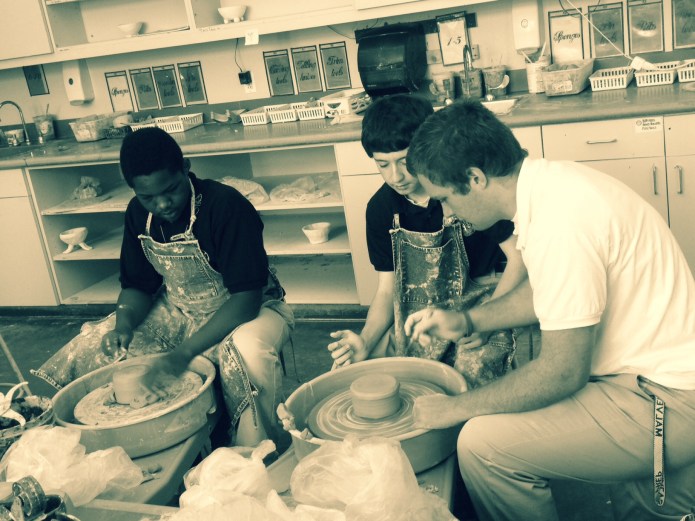
But then I realized – this was perfectly natural. It takes a bit to get back into the swing of anything. Anyone who spends time in that studio has felt a struggle at the wheel in one way or another, and I am always willing to help in any way I can. The same was for people who helped me. My teacher and different classmates helped me get back into it. They guided my hands and did demos for me. I now have a leather hard teapot and 15 red cups on my shelf, all of which I am proud of.
I had to go home a few times with the dreaded red clay stain on my pants. The memories of struggling and being frustrated with the clay remained with me. But now I’ve made 15 cups, and the next 15 can be cranked out with one sitting at the wheel.
I now can make the teapot body and cups with ease, but only because some people helped me. They and I went home with that same dreaded Brooklyn Red stain on our pants.
– Brian
Yesterday afternoon, throwing cups in the studio with Drew and Brian, I was listening to them talk about what every senior I teach is talking about within two minutes of any conversation’s start: college applications.
I watched them work – these talented, thoughtful, and generous young potters who can make wondrous things even without full focus. And I found myself remembering what it felt like to be on the same cliff where they stand. Not knowing the answers is a hard thing, a creeping thing, the type of distraction that can pull us away from feeling immersed and centered even in the work that we love.
It’s not surprising that every conversation comes back to college. The type of pressure they face on what is, for many of them, their first really big life decision – from teachers, parents, counselors, each other, and most of all, themselves – is nothing short of a mountain.
I’ve been reading lots of interpretations around Csíkszentmihályi’s work on Flow. In a number of papers and books, Csíkszentmihályi presents that in order to achieve a Flow state, one must be involved in an activity with a clear set of goals and progress. Right now, the task of making 200 cups and doing 200 interviews seems daunting – but we have clear goals and clear progress to make. Yesterday afternoon, it was 5 PM before any of us realized we had just spent nearly three hours after school throwing cups.
By contrast, the college decisions facing my students have unclear goals (“My top three are __, ___, ___, but I also like ___, but I don’t know if I have the scores for ___…”), sporadic progress (“I have to wait back on my SAT scores… still have to finish my common app…. this one school has like nine extra essays to write…”), and big parts of the process that are far out of their control.
I want to tell them that it’s going to be okay. With their talent, insight, and generous approach to the world, they will be more-than-fine wherever they choose to spend the next chapter of their lives. And I also want them to know that it is okay not to know, and that sometimes, not knowing can be its own gift. From an interview with Chris S., a distinguished artist and teacher:
One of the most profound things I heard when I was a graduate student was when I asked one of the professors what he thought of some of my artwork, and he said, “I don’t know.” And I had never heard a teacher say, “I don’t know.” What a remarkable gift that was, for someone to express doubt. In him doing so, it made me feel okay about myself, because I knew there was so much I didn’t know. And here’s the teacher who’s supposed to know very willingly saying he didn’t know. In him doing that, it allowed me to engage more fully in the creative process of allowing me to do my own work, because it told me I was okay, that I didn’t have to know all the answers.
I want to tell them all this. But I also remember that cliff of not knowing, and how scary these big decisions seemed in my own life. So instead, I offer red clay and the task of 200 freeform cups, 1-2 pounds each, in a little less than a month, and a progress chart.
Here’s to finding flow where we can.
-KP

 FLOW Project 2013